
+371 29 164 268


THE HISTORY OF KALKUNE

Kalkune celebrated its 500th anniversary and a huge number of events have left their mark on its history.
Until the 17th century, the border of two states passed and there was a customs.
Kalkune is the birthplace of the Dinaburg brick. Manufactory produced the material for the impregnable walls of the Dinaburg fortress.
Yeast was also produced here. It was used in baking throughout the Russian Empire. Real gold was added to the famous liqueur that was produced here!
Baron August von Ettingen, who was the mayor of Riga for several years, built his house here, similar to a medieval castle.
The famous Latvian poet Janis Rainis spent his childhood here, and August Kitsberg, the first Estonian playwright, worked as the accountant in the distillery.
According to one version, Marta Skavronskaya, the future Empress Catherine the First, lived here with her relatives.
WWI on the Daugavpils territory
Mailway St. Petersburg - Warsaw
Railway and the Kalkune railway station
The war of 1812. Dinaburg fortress and military actions in Curland


The Ettingen family

Hamilcar von Felkersam,
«the peasant liberator»

The Kalkune Manor

Dietrich von Kaiserling, the owner of the Kalkune Manor

Brick manufacture in Kalkune

Kurzeme-Zemgale duchy. First information about Kalkune

Master Valter von Plettenberg and Livonia

Yekaterina I
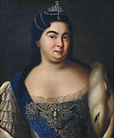
Michal Kleofas Oginski

Janis Rainis

August Kitsberg

WORLD WAR I ON THE TERRITORY OF KALKUNE
Novoaleksandrovsk (Zarasai) burns in the fire. In September 1915, the terrible tragedy completely destructed the territory of the present Medumi, Kalkune, Demene and Svente volosts of the Daugavpils Territory.
Under the pressure from the German army, the exhausted Russian troops retreat. The Germans, regularly receiving reinforcements and ammunition, in accordance with the categorical order of William “By all means to get to the line of the Western Dvina,” crowded the Russians. The inhabitants of Dvinsk, hearing the cannonade more and more approaching every day, fled in panic, abandoning their acquired property for centuries. The city seemed extinct.
If the Germans had managed to break through to Dvinsk, then there would have been nothing left from direct artillery fire, like in French Soissons or in the nearby Ilukste on October 10. Carts and rear facilities were already located beyond Dvinsk. The village of Vishki and nearby villages became the rear points of the retreating Fifth Army.

The First World War (July 28, 1914 - November 11, 1918) is one of the largest armed
conflicts in the history of mankind.
The participating countries split into two coalitions: the Triple Entente (France, Russia and Britain) and Quadruple Union: German, Austro-Hungarian, Ottoman Empires and the Bulgarian Kingdom.
In total during the war, more than 70 million people were mobilized in the army of the warring countries, including 60 million in Europe, of which 9 to 10 million died. Civilian casualties are estimated at between 7 and 12 million; about 55 million people were injured. The war served as a precursor of a number of major revolutions, including the February bourgeois and October socialist 1917 in Russia, and the November 1918 revolution in Germany. As a result of the war, four empires ceased to exist: the Russian, Austro-Hungarian, Ottoman and German empires.
In 1915, the German command transferred the main forces to the Eastern Front in order to withdraw Russia from the war, taking the Russian army into gigantic "ticks". The Russian Headquarters, in order to avoid the encirclement of the Russian armies in Poland, began a strategic retreat to the East. At the end of summer, having captured the territories of Austrian Galicia, Poland and Lithuania, German troops approached the territory of present-day Latvia But the German plan failed: thanks to the retreat, the Russian army escaped encirclement and defeat. By autumn, the front line Riga - Dvinsk - Baranovichi - Pinsk - Dubno – Tarnopol stabilized.
In August 1915, the inhabitants of the Kalkune autonomy, located near Dvinsk, was evacuated to the city of Sebezh (Russia) where the entire archive and securities of the Kalkune volost disappear and die. 95% of the volost inhabitants leave Kalkuny and seek refuge in Russia.
The Russian command built a special railway line bypassing Daugavpils, connecting the Riga-Oryol and Warsaw railways through the Malinovka and Vishki stations. German airplanes were already dropping bombs on the city.
On October 18, the decisive moment was played by the arrival at the last moment of the 12th Caucasian Rifle Regimen. It was urgently sent from Polotsk by four echelons to the Dvinsk freight station, where, in turn, all the army’s cars were delivered. Arrows with rifles, machine guns and cartridges, leaving everything heavy on the train, were seated in cars and quickly taken straight to the battle. The first cars rode the orchestra. An hour later, empty cars returned back, where again the military of the next echelons sat down.
In the village of Medumi, in this quiet and cozy place, full of poetry and stunning nature, from September 6, the German commanders and soldiers have already been accommodated in the beautiful dachas of the Petersburg aristocracy. Russian soldiers were in the woods three miles from Medumi.


Caucasians with short strong counterattacks knocked the Germans out from Medumi and its environs and quickly dug in on high ground on both sides of the highway. The Germans attacked the positions of the Caucasians in order to break through to Dvinsk, but by the evening of the same day Dvinsk was recovered, and the Germans had to part with the beautiful estate of Meddum and settle down behind the lake, in a deserted area, in a moist swampy forest.
Maybe that's why then they so violently bombed and destroyed Medumi. The estate was literally swept off the face of the earth.
For a while, a good waymark for artillery was the church in the town of Egypt. Later, noticing this, the Germans demolished the church tower, and only walls and part of the roof were preserved. The Egyptian post station, which had been operating since the construction of the St. Petersburg-Warsaw tract in 1836, was destroyed.
The third battle line of the Hindenburg passed in the vicinity of Egypt (Latvia) and Smeline (Lithuania) passed. The line of fire and death - this is what this front line was called. The eastern front from the Baltic Sea to the Russian-Romanian border was about 850–900 km, and although the front line along the territory of the Daugavpils region was relatively small, it did not differ in cruelty and loss from others. Residents of these places left, and the German military headquarters settled in Smeline. In the occupied territories, the Germans built a narrow-gauge railway, which delivered ammunition, and exported wood and cattle.

Many houses in the neighborhood were destroyed, and the logs were used for the construction of fortifications. The building of the destroyed church in Smeline was also demolished to the ground. The Smeline cemetery was destroyed by trenches, two tunnels were dug under the cemeteries. The entrance to the tunnels was from the southern side of the hill and went at an angle of 45 degrees inland under the cemetery. The walls of the tunnels were consilodated with logs and sheathed with thick boards, clay pipes attached to the ceiling were attached for ventilation
Wooden stairs were also made and railings were arranged on the sides. Many dugouts were dug for the German soldiers to live and store military equipment in. Almost all of them had windows, and some even with a porch decorated with columns. Trenches occupied a vast territory. On both sides of the front, the trenches were divided into 3 lines:


1st - the most dangerous and deadly, where there was a constant firefight, and the position all the time changed in one direction or the other. According to the plan, people had to be changed once a day, but in reality during severe battles they were changed less often than once a week. In the last years of the war, a rotation of soldiers was introduced, and everyone fell on the 1st line of “hell”.
2nd — support, from where 1 line was supplied with soldiers and ammunition. There the soldiers could write letters, play cards, etc.
3rd — line of officers and commanders. Also there was a feldsher point. The surviving soldiers from the 1st line brought the wounded here, and then they could have a rest and wash themselves.
With active shelling, the soldiers could not wash, comb their hair or change their clean clothes for weeks or even months. There were not enough cigarettes, and the soldiers were forced to light their notebooks or prayer books. Lice, fleas and rats were permanent residents of the trench. There was a stench everywhere.
In cold and rainy weather, everything was wet, feet stuck in the mud. But still, it was better than leaving the trenches, where death was expected. For retreat or refusal to fight, one was threatened with execution for desertion. Often there was a lack of food, which, along with ammunition, were supplied by rail, but it was dangerous to bring food to the frontline. All livestock remaining in the surrounding farms was eaten.
The soldiers were starving, various diseases appeared. The burdens were the same for all the warring parties on the Northern and Western Front throughout Europe. As one French soldier Tanti said in his notes, a soldier becomes like a creature between a human and a chimpanzee, born of the 20th century. It was a monster of civilization, the development of which went in the opposite direction. His only human trait was the ability to suffer.
Generals and politicians seemed deaf and blind, not seeing the suffering of ordinary soldiers. The surviving letters of the soldiers of that time express pain, despair and misunderstanding of the monstrous stupidity of what is happening.
It was a new kind of war - a destructive war of extermination. The goal was to kill as many people as possible in the shortest possible time. More deadly gas poisoning shells appeared. During the war, chemical weapons were actively used; perhaps the invention of the German army was also used here - flamethrowers


For several decades after the war, the vicinity of the region remained overgrown, entangled with barbed wire and deep communications in the trenches. In the 20-30 years of the 20th century, these places gradually began to settle settlers from Krustpils.
As the only reminder about the difficult years of this region, there are now monuments to the fallen Russian soldiers and crosses in the cemeteries of German soldiers. The common graves of Russian soldiers were reburied after the war - in 1930-1932. The white monuments and the area around them were designed by the communications engineer of the Daugavpils district J. Komisar
It is still unknown - how many soldiers are buried there, why even talk about their names - all are unknown. German cemeteries were landscaped and remodeled after the war in collaboration with the German government. In most of the graves, the names of soldiers, the rank, date of death, and the number of regiment and company are known.
According to the dates on the crosses, one can understand that there were no large-scale battles, and there were constant skirmishes from the autumn of 1915 to the spring of 1918. In the volosts of Medumi, Demene, Kalkune and Svente there are 7 known burial places of Russian soldiers and 14 cemeteries of German soldiers.
Обобщены материалы Лео Трукшана, Юрия Чертова, Миропии Петкун и из интернета в 2014 году. Бригита Маделане
MAILWAY
"ST. PETERSBURG - WARSAW"
In 1836, a St. Petersburg - Warsaw postal route was opened, which passed through Pskov, Rezekne, Daugavpils, Zarasai, Utyany, Kaunas, Golgotha and Suwalki. The construction of the railway cost 1 million 225 thousand rubles and was of great importance in political and economic life, as communication between the Russian Empire and Europe improved. About 200 roadside infrastructure facilities were built, including 50 postal stations of three different types.
For the maintenance of the railway, buildings for various purposes were built every 7-10 versts, e.g. postal stations, inn, station housekeepers' houses, stagecoach stations. Road outposts, houses of security guards nicknamed gatekeepers, as well as outposts of customs officers and gendarmes, were called upon to protect passengers "from highway robbers." These services were needed to control smuggling, as well as toll collection. The one mile fare was 3 kopecks, for 100 miles it cost 3 rubles, which was big money at the time; for three rubles it was then possible to buy a cow.
The tract was about 13 meters wide and its length was 1250 km. The carriageway had a hard surface of compacted gravel, on the sides of the road was hewn with hewn stone, and deep ditches passed on both sides. A total of half a million birch trees were planted on its two sides; a wide green stripe framed the road, which made it possible to organize a halt and harness the horses which needed a rest from time to time, just like the travellers.
At the post station it was possible not only to change the horses, there were also rooms for travelers, as well as barracks and workshops. In the basement of the post stations there were storages with safes, rooms for supervisors and a room for the detention of prisoners.
The stone buildings of such stations were built with an interval of fifty kilometers, according to the best practice designs.
On the territory of modern Latgale, 8 postal stations were built along the highway, one of them in Dinaburg, and the closest in Egypt, near the Kalkuni estate. A first-class station was built there according to the project of architect Staubert, which consisted of a central two-story red brick building and several utility buildings. The station was large and noisy, crowded with travellers, service workers and merchants, there were also many horses.
A stagecoach station was opened in the neighboring Novoaleksandrovsk for its maintenance, and the town began to develop rapidly. During the World War I, the front line passed here, and the place of Egypt was almost completely destroyed during the bombings.
The royalty of the Russian Empire stopped by at the postal station of the Dinaburg fortress on their way to Europe, where the Travel Palace was arranged for them. All employees of the road were assigned to the military department, and during the passage of the king they lined up along the highway in full dress. At all the postal stations, it was required to keep 24 excellent horses for the king to travel with.
The construction of the important road for the Russian Empire was completed in 1836. Brigades coming from St. Petersburg and Warsaw met near Utena. In connection with this significant event, Nicholas I, paying tribute to the builders, ordered to install a cast-iron 11-meter obelisk in Zarasai (on the territory of modern Lithuania). It was erected by the banker and merchant Peter Steinkeller (1799-1854). The obelisk that survived in its original form until the beginning of the 20th century was decorated with a double-headed eagle. The monument had a board with the inscription: "By decree of Tsar Nicholas I, a road was drawn from Kovno to Dinaburg (193 versts) in 1836." A fragment of the board was stored in the Zarasai Museum of Local Folklore, but now it has been handed over to Rokiskis museum.

Mailway station in Utena (Lithuania)

The stagecoach accommodated eight or more passengers. It is known that stagecoaches followed a specific schedule from Kaunas (Kovno) to St. Petersburg. On Mondays and Thursdays they delivered light load, on Tuesdays and Fridays – heavy load, and on Saturdays - urgent mail. Stagecoaches transported letters, various government papers, money, and jewelry. Political prisoners escorted by an armed convoy as well as recruits were transported.
When the railroad took over the flow of passengers and goods, many buildings on the sides of the highway lost their purpose. Over time, they lost their original appearance, and some completely disappeared
(Pēc Jonas Pleckevičus grāmatas” Senais trakts Sanktpēterburga - Varšava)
RAILWAY AND THE KALKUNE RAILWAY STATION

The "Imperial Command" of Emperor Alexander II of March 1, 1852 indicated:
1. Build a railway from St. Petersburg to Warsaw.
2. The name of it shall be "The St. Petersburg-Warsaw railway".
3. Work to commence in 1852, to start both from St. Petersburg, and from Warsaw.
From the Circular:
All work management is divided into 8 departments:
1st branch from St. Petersburg to Luga 127 versts.
2nd branch from Luga to Pskov 128 versts.
3rd branch from Pskov through Ostrov to Rezhitsa, 154 versts.
4th branch from Rezhitsa to Dinaburg, 83 versts
5th branch from Dinaburg to Vilna, 146 versts
6th branch from Vilna to Grodno, 136 versts.
7th branch from Grodno to Bialystok, 72 versts.
8th branch from Bialystok to Warsaw 164 versts.
1,010 versts in total.
Pavel Petrovich Melnikov (1804-1880) was a Russian engineer - general, Minister of Railways of the Russian Empire in 1865-1869, and a designer and a builder of a protective dam against floods in Dinaburg, St. Petersburg-Moscow railway, St. Petersburg-Warsaw railway.
On July 12th 1852, the construction management staff was approved. E.I. Gerstfeld was appointed the head; engineer S.V. Kerbedz, a famous builder of railway bridges, was appointed as his assistant, and academician K.A. Skarzhinsky was the chief architect. A concession was signed with foreign entrepreneurs for the construction of the St. Petersburg - Warsaw - Prussian border.

P. Melnikov
For this purpose, the Main Society of Russian Railways was formed. The board consisted of bankers from England, France, Germany and other European states, in addition to St. Petersburg banker L. Stieglitz. The general technical management of the construction process was carried out by the Corps of Railway Engineers.
Despite the fact that the railway was built at the expense of the treasury, all work carried out by the contractors. The construction of the road to Warsaw was offered to the merchant and entrepreneur Grigory Gladin for 20 million rubles. This money was used to lay a 500-verst section of the road from St. Petersburg to Dinaburg. The contract for the construction of the railway from Dinaburg was given to the merchant of the first guild, Yakov Adelson. The section of the road from Warsaw to Dinaburg, including the railway bridge across the Western Dvina (Daugava), was carried out by contractors and engineers from Europe.
The railway was built in separate sections. Construction of stations, wagon and locomotive depots, residential buildings for workers and employees, utility rooms and workshops was carried out simultaneously and relatively quickly.
The length of the road was 1280 km, the embankment and artificial structures were prepared for two tracks, but only one was laid. The rails were purchased in England, Belgium and from Demidov's factories in Ural Mountains.
Standard designs of bridges and various structures were used during the construction of the railway. The author of many projects was Poiron de Mondezir. The construction between Rezhitsa and Dinaburg was carried out according to his project. Stone parts of four bridges between Poskov and Dinaburg and ice axes of the bridge across the Daugava were also built under his management.
Pirel was involved in the design of stations, depots and other buildings. According to his project, first a temporary, and then a permanent station in Dinaburg was built.

The bridge across the Western Dvina (Daugava) was being built almost three years. During the construction in the dark, electric floodlighting was used for the first time. Installation work was carried out in two to three shifts. The metal structures for the bridge were supplied from France and Belgium.
The Dinaburg station, was built according to a typical French design. It was considered a first class station and had a heating system and other amenities.
The station had a hotel, a restaurant and separate apartments for the rest of the royal family and dignitaries.
The first 100 steam locomotives were ordered abroad and built in Manchester, Paris, Vienna and Saint-Pierre; later, Russian-built steam locomotives were used.
On November 8th, 1860, a section of the road from Ostrov to Dinaburg began its operation, and on May 9th, 1862 traffic for trains from Dinaburg to Kovn (Kaunas) was opened. The first train on the constructed road from the capital of Russia, St. Petersburg to Warsaw, ran on December 15th, 1862.
The total length of the road was 2,699 kilometers.
In 1895, the railway was bought by the state.


The trains of the Warsaw Line were distinguished by comfortable and richly furnished carriages, which were primarily intended for first class passengers. They looked like small rooms with soft sleeping areas and mahogany and bronze walls. In particularly luxurious carriages, passengers could even take a bath. The most comfortable and beautiful were the cars of the imperial train, but besides it, other “family” trains belonging to the richest and most influential Russian families went along the Warsaw line. For example, the Yusupov princes had their own family train.

During the first years, the train traffic on the newly built St. Petersburg - Moscow and St. Petersburg - Warsaw railways was not very regular. The traffic was regulated by the schedule and hours supplied to the agents. With the increase in the number of trains, there was a desperate need for signalling.
On the St. Petersburg - Warsaw railway, the first provisions on signalling were created and the first types of signals were introduced: in 1857, signal horns, red discs, signal flags and lanterns, firecrackers, and a signal rope were introduced.
In 1871, the construction of a railway began, connecting the "grain" regions of Russia with the ice-free Libava (Liepaja) port.

One of the sections of the railway under construction was the section from the Kalkune station to the Libava station. By 1872 the railway connected the port of Libava with the town of Romny. This railway became known as Libavo - Romenskaya. The road started from Libava, passed through Kalkune, Vilno, Vileika, Minsk, Bobruisk, Gomel, Bakhmach, and terminated at Romny.
The Kalkune railway station was built in 1861-1862. Since 1872, the Kalkune station has become the largest station at the intersection of two railways. The station was marked on all maps of the routes of communication in Russia. The newly opened railway was used to export grain to the port of Libau.
August von Ettingen, using imported grain, started industrial production of alcohol, yeast, and leather production at his distillery. Mills for grinding grain were built, since it turned out to be more profitable to sell flour abroad.


After Latvia gained independence in 1920-22, Kalkune parish became a part of Laucese parish. The Kalkune railway station was named after the nearby town of Griva. Since 1922, the railway station has been renamed "Griva".
Janis Rainis, a notorious public figure, writer, poet, minister of education and his wife, the poetess Aspazija started their emigration journey from the Kalkune station on December 31st, 1905.
The work of Kalkune station was later disrupted by the First World War. The advancing German troops could not use the local railways, because the gauge of Russian roads did not match the Western European (the Russian gauge was 1520 mm, the western gauge was 1435 mm). The construction of narrow-gauge railways began on the occupied territories, which were used to transport ammunition to the warring troops and for export of expropriated goods: timber, livestock. This is how the narrow-gauge railway Rokiskis-Obelyai-Kalkuny was built. The tracks were dismantled in the 1920s.

During World War II, in order to increase the capacity of the Griva station, German troops set up a Daugavpils patrol route - 3 km, which allowed trains from the Daugavpils station to go to the Egleine station without entering the Griva station.


During the Soviet era, the station was redeveloped. Access roads to the distillery and brick factory, trade centres and warehouses were created. Semaphores were replaced with traffic lights, all railway switches became automatic.
Traffic through the station was intense, there were many freight trains. Short and long-distance trains also passed through the station.
Griva station

WAR OF 1812.
DINABURG FORTRESS AND MILITARY ACTIONS
IN COURLAND
The coup d'etat of the 18th Brumaire (November 9, 1799) resulted in France getting into Napoleon’s hands at a time when old Europe was in complete chaos. While still a commander in chief of the Italian army, Napoleon began the redistribution of the political map of Europe, and at the time of his expedition to Egypt and Syria he had grand plans for the East.
Becoming the First Consul, he dreamed of removing the Britons from India. As a result of numerous military operations, the French Empire reached its largest size, and, together with vassal and allied states, included almost all of Western Europe.
In 1812, a war broke out between the Russian and French empires on the Russian territory. This did not come as a surprise, and Russian empire took a number of actions to protect its western borders - borders were strengthened, new fortresses were built.
In the summer of 1810 by order of Emperor Alexander 1, new construction began on the territory of the dilapidated fortress of Dinaburg. The fortress was to consist of two parts - a bridgehead on the left bank of the Western Dvina on the lands purchased from Baron von Keyserling (owner of Kalkuni), and the main fortification on the right bank.
Construction was carried out at an fast pace, and a huge number of soldiers and civilian employees were recruited for the construction of the fortress. Due to lack of space in the fortress itself they were placed in camps on both sides of the Daugava. For the production of bricks, which were required in a huge amount in the early years of construction, Keyserling brick factories were used.
On June 30, 1812, the first units of the French cavalry from the current Zarasai (Lithuania), appeared on the territory of Kalkune, and on July 1st the troops were concentrated here to attack the Dinaburg fortress.


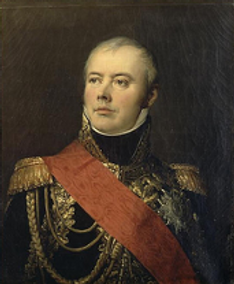

The troops of Marshal Undino, in which there were 32,000 foot soldiers and 2,400 cavalry soldiers, tried to take the bridgehead of the Dinaburg fortress, but their attacks were unsuccessful. With heavy losses, the infantry had to retreat; the attack of General Marbo’s cavalry on a shaky river crossing was also unsuccessful.
At this time, the headquarters of General Jean Etienne MacDonald was located in Kalkuni. Here, on the estate, he spent almost two weeks coordinating the actions of the French troops. After the withdrawal of the Russian army, the French troops managed to occupy the Dinaburg fortress without a fight and destroyed its fortifications, drowned guns and burned the warehouses.
Having occupied Courland, General MacDonald sent his troops to Riga, where he remained until the end of the military campaign and joined the remnants of the Napoleonic army during its retreat.
Etienne-Jacques-Joseph-Alexander MacDonald came from a poor Scottish family, who was forced to flee to France after losing the uprising for independence. MacDonald received a good education, and, despite the desire of his father to see him as a priest, he entered military service. He made a brilliant career as a general of the Napoleon army, earning the title of Marshal of the Empire.
MacDonald was particularly distinguished at the battle of Wagram, and fought with Alexander Suvorov himself. After the abdication of Napoleon, he was appointed the peer of France. His loyalty to Napoleon was amazing, he was the last of the marshals who left the emperor. After the second occupation of Paris by the Allied forces, MacDonald was entrusted with a difficult task - to disband the Napoleon’s army.
A few years after the abdication of Napoleon, MacDonald, swearing allegiance to the king, continued his career and received the rank of General of the Royal Guard and the position of Grand Chancellor of the Legion of Honor; he sits in the house of peers and is especially close to the royal person. After the July Revolution of 1830 he had to resign, and he spent the last ten years on his estate.
Alexander MacDonald's statue in Louvre
THE ETTINGEN FAMILY

The Ettingen family has been known in Europe since the year 987. One large branch of the family, Ostsee, left its mark on the territory of modern Latvia. At the end of the 19th century, the Öttingen clan was very famous and had a great influence in Estonia, which was part of Livonia. A museum of the Öttingen family has been created at Kuremaa Manor, and a chapel and burial places are also located nearby.


Ettingen family's coats of arms

Father Alexander von Ettingen
1798-1846.
Landrat, land marshall of Livonia

Mother Helen von Knorring
1794–1863
The Ettingens could be proud of their six sons. All brothers were members of the “Livonia” Corporation, three were professors at the University of Tartu (Dorpat), and the other three were representatives of the Livonia Knighthood. All six brothers held important positions in various institutions and supported each other.
Youngest siblings of August von Ettingen, the owner of the Kalkune manor:
George Philip von Ettingen (1824-1916)

Doctor, professor of clinical surgery and ophthalmology in Tartu, Bonn and Berlin. He held a medical practice in Tartu, Riga, North America and St. Petersburg. From 1854 to 1870 he was the head of the Department of Clinical Surgery at the University of Tartu, was the vice-rector of the university, the dean of the medical faculty; and from 1868 to 1876 - the rector of the University of Tartu.
From 1878, George Phillip was the mayor of Tartu. After the Russo-Turkish war, during which Georg Phillip worked as head physician at the Red Cross Hospital, he wrote the first monograph in the world on shot eye injuries. Ettingen wrote many other scientic papers on surgery and eye diseases. He also taught many prominent doctors of the new generation.
Nikolai Conrad Peter von Ettingen(1826-1876)

Economist, banker, judge in Tartu, Land Marshal of Livonia.
Alexander Constantin von Ettingen (1827-1905)

Theologian. He studied theology at the universities of Tartu, Erlang, Bonn and Berlin. He received a master’s degree, then a doctor of theology, and later a professor’s degree in systematic theology. He founded the newspaper (Dorpater Zeitschrift fur Theologie und Kirche) and the theological society at the University of Tartu. Alexander studied mass manifestations of social ethics, was interested in the history of literature, religious music, and fine art.
He published several papers on ethics, philosophy, literature. In some of them Alexander promoted new statistical method, for which he received a prize and was elected an honorary member of the London International Statistical Committee. Alexander von Ettingen contributed greatly to the improvement of Tartu.
Edward Reingold von Ettingen (1829-1919)

Head of the of churches and education in Livonia. Agriculture Specialist. He owned an estate in Kuremaa, Estonia.
Left to right: Edward von Ettingen with his two grandsons (Rolf and Nikolai) and his son Eric
Arthur Joachim von Ettingen (1836-1920)

Professor of physics, music theorist, meteorologist, phenologist. Correspondent member of the St. Petersburg Academy of Sciences. He lectured at the universities of Tartu and Leipzig. Born in the estate of Luua, which later belonged to him.
He studied natural sciences in Tartu, in Paris, in Berlin. He wrote many famous scientific papers in the field of physics and meteorology. In 1865, in the tower of his brother’s house in Tartu, he founded the meteorological observatory - the first in the Baltic States, which operated for 60 years. Arthur invented new meteorological instruments, including the tool for determining the exact speed of wind. He contributed to the creation of a network of weather stations in the Baltic States, where meteorological observations were conducted 8 times a day.
The owner of the estates in Kalkuni and Medumi
Augustus George Friedrich von Ettingen

Augustus George Friedrich von Ettingen had lived a long and outstanding life. He was born on July 5th, 1823 in the town of Wissusti on the territory of modern Estonia on his father’s estate. As the eldest son in a wealthy family, Augustus received excellent education: from 1841 to 1843 he studied law at the University of Tartu and then received a doctor’s degree in law in Heidelberg (Germany).
Augustus started off as a local judge in Tartu, subsequently receiving the title of State Councilor. From 1857 to 1862 he served as Land Marshal of Livonia. In 1862 he was awarded the title of chamberlain of the imperial courtyard. At the courtyard of Tsar Alexander II, he was organizing entertainment and attractions (maitr de plaisir). In 1868, Augustus von Ettingen became a member of the Riga City Council and the head of the real estate department. From 1886 to 1889, he served as the mayor of Riga. However, at this time, intensified Russification of the provinces of the Russian Empire began, which was directed against the dominance of the Baltic Germans in the state administration.
A. von Oettingen tried to fight against this, using his previous connections at the courtyard. But soon he had to leave Riga, and he settled in his estate Kalkuhnen, which was noted as one of the leading points of Germanization in Russia. Due to his influence, Etingen was nicknamed the “Baltic Duke”.
It is noted that August von Oettingen was a tall, strong, handsome man with a very good sense of humor. He had a lot of connections, was aware of the latest trends and followed the ongoing developments in the social and economic life of the Russian Empire. August von Oettingen was married to Ida von Wilcken (1827-1903). The family, according to the tradition of those years, was big - they had five children.

The eldest son Alexander (1848-1877), the landowner of the estate in Lielborn, died young.
Burchard (1850 - 1923) was a great horse lover and specialist in horse breeding in Germany. Subsequently, he was the head of the bank of the city of Mane. For several years he worked as the director of the Phoenix car factory in Riga.
Third son George (1851-1916) – was a landowner in the Courland province.
Daughter Maria (1857-1883), was married to Heinrich von Wolf, whose sister was the wife of the famous Count Zeppelin, the inventor of the aircraft carrier.
One of the most beautiful legends of love is associated with Maria, or Marissa, as she was called in the family. Her husband, who adored her, built her a magnificent Alt Schwanenburg estate in the vicinity of Gulbene. But love did not save her from a terrible disease, and at the age of 25 she died of tuberculosis

Burchard
George
The youngest daughter Helena (Ella) (1860-1885), who married Alexander Ukskul-Gildenband (von Uexküll-Güldenband), also died at a very young age. Tuberculosis was a cause of death of huge number of people at that time.
Due to unsuccessful business projects, dishonest managers and many debts, August von Oettingen was forced to sell his Kalkune manor in August 1897 to Count Nikolai Ignatiev and move to his estate in Estonia. August von Oettingen passed away on April 7th 1908 at the age of 84 in the city of Yuriev (Tartu).
HAMILKAR VON FELKERSAM,
"THE PEASANT LIBERATOR"

The Felkersam barons belonged to one of the oldest noble families in Europe, known since the mid-12th century. In Livonia, the Felkersams appeared presumably in the first half of the 15th century. The founder of the family was Johann I, whom the Dinaburg mayor Wilhelm von Finterberg in a letter to Lübeck on August 24, 1544 calls "a respected good man was devoted to Vidzeme lands since his early years and served his land faithfully; he was also involved in information gathering, recruiting and doing good for this land. " As the commissioner of the Order around the year 1515 he settled peasants in the vicinity of Dinaburg.
In 1519, the master of the Platenberg order leased him the land of Kalkuni (in the vicinity of Dinaburg). During his lifetime, Johann I gave Kalkuni to the eldest son Melchior I. Melchior’s son Johann II, the Dinaburg judge, was finally confirmed as the legal landowner of Kalkuni in 1956. Following the results of the Northern War, Livonia and Estonia became a part of Russia, and only the Duchy of Courland retained relative independence. It was at this time that the class of the richest and most influential land owners was formed, which determined the economic and political life in Courland.
The eldest son of Johann II Cupronickel III was an excellent organizer, well educated and energetic. He served as an adviser and then chancellor of the Duke of Courland Jäkaba during the difficult times of the Polish-Swedish wars. As a delegate to the 1660 Olivian Peace Treaty, with tireless diligence, courage, intelligence and eloquence, he sought liberation of the Duke from Swedish captivity. His family ceased to exist around 1700, and soon afterwards they lost their Kalkuni lands.
Frederick William, the Duke of Courland, died in 1710. His widow, Anna Ioannovna, who was also the daughter of the Russian Tsar Ivan V, was enthroned. She contributed to promotion of the nobility of Courland. By this time, the petition of the vice president of the Livonia court Georg von Felkersam emerges in which he gets appointed a general director of economics on the island of Ezel (Saarema).
Five years later, he was granted land in the county of Riga by a registered decree of May 22 1730. Subsequently, the Felkersams played a prominent role in the Russian Empire. By this time, the Felkersams owned a lot of forest land, including in land in Kurzeme and Piltene, numerous plots in Vidzeme, and on the border with Lithuania and Poland.
The most striking personality among the brilliant representatives of this family was Hamilkar Georgievich von Felkersam (01/06/1811 -19.05.1856), who was the civil governor of Livonia from 1829 to 1847.

Since childhood, Hamilkar was distinguished from his peers by an insatiable hunger for knowledge, as well as intelligence, perseverance and determination. Despite the fact that by the age of 19 Hamilkar was already a very well educated young man, in 1829 he enrolled into the University of Berlin, where he studied natural and historical sciences and philosophy. Returning to his homeland, Hamilkar von Felkersam actively promoted the ideas which, in his deep conviction, will lead to the economic prosperity of the Ostseen lands.
He said: "The value of a person is determined not by the rights that he possesses, but by the duties that he assumes."
In his speeches, Hamilkar von Felkersam defended the idea of giving the peasants greater land rights. According to the law signed by Alexander I (1919), peasants were personally recognized as free, but were not endowed with land and couldn’t freely choose their place of residence, so they had to agree to any enslaving conditions put forward by the landowners. This was supposed to prevent hunger riots and make the work of peasants much more effective. Hamilkar von Felkersam’s ideas met fierce resistance of large landowners.
In 1846, Emperor Nicholas I created a special Ostsee committee which included Hamilkar von Felkersam in order to consider some of the land use issues. His active work in the committee soon began to bear real fruits, and his personal influence grew. In 1847, he was elected a member of the board of Vidzeme, and since 1848 as a land judge. Elected in 1848 by the provincial leader of the nobility, Hamilkar achieved the establishment of a Land Bank to finance the redemption of land by peasants.
On July 9, 1849, a new law on peasant land use was approved by Hamilkar von Felkersam. Cash rent was supposed to replace previous lease arrangements. The funds received from the lease and the sale of peasant households into property was supposed to be used by the landowner to expand production, purchase inventory and livestock.
The Landtag of 1856 opposed the adoption of this law, which was one of the speculated reasons for the tragic death of its creator. The unexpected death of a 45-year-old reformer and public figure in the prime of his talent and creativity has generated many conflicting rumours and legends.
But the work of his life was nonetheless continued - the development of capitalist production in the countryside was impossible to stop. The owner of extensive lands of Kalkuni, known as “peasant liberator” and “Livonian Mirabeau”, Baron Hamilkar Georgievich von Felkersam was buried in the family cemetery in Birkineli.

Felkersam's grave in Birkenele
THE KALKUNE MANOR

August von Ettingen was the owner of the estates in Medumi and Kalkune.
Ettingen was not only a politician, but also a businessman. In 1868 he expanded and modernized the brick production on the estate. He also built a water mill that ground the grain, and the produced flour was sent for sale by rail.
In 1873 Ettingen opened a distillery with four modern steam boilers at the Kalkune estate. Over 180 workers were employed at the distillery, and more than 65,000 buckets of alcohol were produced per year. The distillery also produced the highest quality yeast. The yeast production, which was run by businessman named Prahm, was one of the largest in the Russian Empire. It was exported to all the large cities of Russia and Poland, which was then part of the Russian Empire. Even the famous Filipov's Bakery used it for baking.
There are some anecdotes about resourceful residents of the estate who put the leftovers from the production of alcohol to a practical use. There was a large tank near the plant where hot ferment was poured out, and the locals secretly took baths in it, believing that it helps against rheumatism.
There was a large farm, a slaughterhouse and a leather processing workshop in Kalkune, so ferment was also used for fattening the cattle.
High-quality vodka “Aqua Kalkunensis” and various liqueurs, for example, the well-known plum and coffee liqueur “Puss-Cafe”, were made in Kalkune. A variety of ingredients were added to the liquors, for example, rose oil and small flakes of gold.

Oettingen was on friendly terms with German Chancellor Otto von Bismarck, who often went hunting in the Oettingen forests in Medumi. The Chancellor always brought his favourite “Aqua Kalkunensis” with him to Germany. Bismarck received a whole box of this drink by post from Kalkuni every year for his birthday.

As a zealous owner, Ettingen took care of the amenities and their inhabitants. Under his rule a stone bridge over the Laucese River on the Mane was built, and crossing the bridge incurred a charge.
All homeowners in the town of Griva - Zemgale paid land rent to the owner of Kalkune.
A huge estate flourished under his rule. An area of more than 3,000 square meters turned out to be a great hunting ground. On one of the peninsulas of Lake Medumi, the owner built a luxurious hunting castle - a wooden building with towers, terraces and a spire, calling it Monte Kovalo. Otto von Bismarck, who loved hunting, often slept over at one of the Medumi farms, which earned him a nickname Friedrichsruhe.


Kalkune had an arboretum which sold seedlings and shrubs throughout Russian Empire. The estate also tried to establish the steel production with workforce coming from Germany. Iron ore was transported directly from the Ural Mountains. The production required huge investment and did not give profit, so the plant was sold to the businessman Mukhin, who later converted it to produce linseed oil.
From 1890 to 1892, a new construction was taking place on the site of the former estate, according to the project of the Dinaburg’s chief architect Wilhelm Neumann. The building of Kalkune estate reminds of a medieval castle. The main entrance is decorated with a balcony leaning on small columns, and an unfolded staircase with balustrade railings. Exquisite pediment - a classic element - has not survived to this day. Initially, the facade included a sculpture of Walter von Pletenberg - Comtour of Dinaburg and the master of the Livonian Order.
Unfortunately, the interiors of the estate were not preserved. Around it was a spacious garden, park and artificial ponds where trout was farmed.

Managing Director Loffler was put in charge of the estate but, unfortunately, he turned out to be an dishonest person who purchased a property in Russia with the money of the owner. Many enterprises of the estate did not bring enough income, and due to huge debts in 1897, Oettingen was forced to sell his Kalkuny estate to Adjutant General Nikolai Ignatiev, a statesman and diplomat of Russia.


In 1902, the estate was bought by the merchant of the 1st Guild of Kazan, Vasily Karyakin, whose family also owned the estates in Didrichshtein, Getsenstein and Jaunlaiku.
Karyakin was born in 1851 in Rybinsk (Russia), he was a member of the 3rd Duma and trade adviser. He was involved in various businesses both in St. Petersburg and Rybinsk. Karyakin owned large estates in the Yaroslavl province; a mill in the Kazan province, and Kalkuny factories. As a good merchant and entrepreneur, he was well versed in finances and had accumulated great wealth throughout his lifetime. He died on October 14, 1913.
The estate was badly damaged during the WW I and the subsequent October Revolution, the magnificent building was nearly destroyed and completely looted. The building was restored, but it has become much more modest, has lost its characteristic appearance and internal layout.
After the agrarian reform of 1920, the Kalkune estate was nationalized, and in 1927 the Griva Orphanage was opened there. During the World War II the military hospital opened in the estate. The orphanage resumed work in 1945. In 2004, the social custody centre “Kalkūni” has moved to a nearby building.

DIETRICH VON KAISERLING -
OWNER OF THE KALKUNE MANOR

The Kaiserling family records date back to 1300, when the wealthy Keserlink burghers have been first mentioned in Bielefeld town in Westphalia. Around 1493, Herman Keserlink went to the Baltic states and got enlisted in the Livonian Order. The order recruited young German soldiers and distributed land with peasants in their vassal possession.
Herman’s descendants all had successful careers: they played an important role in the Duchy of Courland (the modern part of Latvia south of the Daugava River). They were chancellors and leaders of the nobility; achieved success in diplomatic, state and military services, as well as in literature.
On September 5th, 1713 the future owner of the Kalkune and Medumi estates, Count Dietrich von Keyserling, was born in the family of Baron Otto Ernst von Keyserling and Baroness Maria Sibylla von der Kek.
Dietrich studied at Koenigsberg and the University of Jena. During the reign of the Empress Anna Ivanovna in 1734, he had worked in the office of his brother Herman Peter von Keyserling, who was an outstanding diplomat. In 1735, he joined the Russian army and fought in the Polish War and the Russo-Turkish War. There he served as a commander of the Azov Dragoons detachment and later became a colonel.
In 1739 he married Baroness Anna Alexander von Manteuffel and they had 16 children together. He later acquired the Bliden estate and became the owner of the Bauska castle. He also served as chamberlain and a secret adviser to the Polish king, as well as a chancellor of the Duchy of Courland.
In 1759, Kaiserling became Chancellor of Kurzeme but left the civil service four years later. For his outstanding service, the Prussian King Frederick William II awarded him the title of Count of the German nation of the Holy Roman Empire. He also was awarded the German Order of St. Anne for participating in the Turkish War. For the service to Poland and Saxony he was awarded the Order of the White Eagle and the Order of St. Stanislav. He was a knight of the Order of Johanai. He died on November 13th 1793 in Jelgava.
THE KAISERLINGS
It is impossible to list all the known Keyserlings. There was at least one other Dietrich von Keyserling (1713-1793) - a Prussian colonel and a close friend of Frederick the Great.
German-Karl Keyserling (1696-1765) kamer-yunker of the Duchess of Courland Anna Ioannovna, was the head of the special “Ministry of the Baltic States”, which was the board of Livonian, Estland and Finnish affairs. Moreover, he was a president of the Russian Academy of Sciences. In a short time of his leadership, Keyserling improved the financial situation at the academy; persuaded the historian Gottlieb Bayer not to leave Russia; and hired the famous poet Vasily Trediakovsky. Under the reign of Catherine II, he and Nikita Panin, became the chief advisers on foreign policies. As an ambassador in Warsaw, he successfully conducted the election of the Russian protege Stanislav-August Poniatowski to the royal throne.
George Johann Keyserling (died in 1711) – the Prussian envoy under the reign of Peter the Great.
Heinrich Christian von Keyserling (1727-1787) – the diplomat in the Russian service;
Count Alexander Andreevich Keyserling (1815–1891) - an outstanding geologist and prominent public figure, one of the authors of the famous paper “Geology of Russia and the Ural Mountains”, which served as the basis for further geological research in Russia.
Heinrich von Keyserling (1831-1874) - a Prussian envoy to Turkey;
Eduard von Keyserling (1855-1918) - a prominent Ostseey novelist;
German Alexander von Keyserling (1880-1946) - German philosopher and writer, husband of the Chancellor Otto von Bismarck’s granddaughter.
Count Archibald Keyserling – the 2nd rank captain of the Russian fleet (1882–1951). For 7 years he was a commander of the Naval Forces of Latvia. After graduating from the St. Petersburg Naval Cadet Corps, he had begun serving as a midshipman in the Baltic sea; later participated in the Russo-Japanese War, in particular, the Battle of Tsushima.
AUGUST KITZBERG

August Kitzberg (1855 - 1927) was the Estonian writer and the founder of the Estonian dramaturgy. He was born on December 17 (29), 1855 in Laatra, Estonia (now known as Viljandi region).
Since 1871, Kitzberg and his brother worked as teachers in Maya, near the city of Karksi-Noia. Nowadays, there is the Kitzberg Museum. At the Maya school the Kitzberg brothers planted a lot of trees that are still growing there to this day.
After finishing his teaching career Kitzberg served as clerk and notary in a parish court in Abye, and as a rural clerk in Polly.
From May 5th 1894 to August 8th 1898, Kitzberg worked in Kalkuni as an accountant at the August von Oettingen alcohol-yeast factory. He decided to move to Courland because he was forced to quit his job in Viljandi in connection with the Russification policy, which was enforced by the tsarist government in the 1880s. A. von Oettingen, who lost the position of the Riga mayor due to the same policy, gave Kitzberg a job in his Kalkune estate, which was considered one of the most Germanised places in Russian Empire. Kitsberg worked as an assistant accountant, cashier and chief accountant, with a monthly salary of 15 rubles, with his living expenses being paid for by Ettingen.
The time in Kalkune was one of the most prosperous and calmest periods in the life of the writer. Factory management took good care of their employees. The nearby city of Dvinsk was quite philistine at that time. The Russian theatre could be considered the only cultural institution, alongside the Russian club, where workers of the Kalkune factory would come to unwind and dance.
In a letter to his niece in 1895, Kitzberg wrote: “My life is good; it is very calm and carefree. Time to eat, time to sleep, and on Sundays we travel to the city. (..), we get daily German and Estonian newspapers, and weekly “Olevik”, “Sakala” and “Tallinn Postimees” (..)
This idyll was over when Ettingen decided to sell the Kalkune estate in 1897. Kitzberg stayed with the new owner until 1898, but soon moved to Riga, where he became the head of one of the departments at the Riga Phoenix Wagon Factory.
In 1901, at the age of 45, he returned to Estonia as a recognised writer. Until 1920, Kitzberg worked at the Mortgage Bank in Tartu (Derpt).
The literary pieces of A. Kitzberg written during his time in Kalkune belong to the first period of his work. Due to his position, he was able to develop close relationships with many people who told him many interesting stories. “Misfortunes come after joys”, “First Christmas tree”, “Tricks of the Reeter Puve” and other stories were written in Kalkune.
Works of the 70s and 80s, the era of national awakening, were heavily influenced by romanticism. In the early 90s Estonian literature reached a turning point towards realism. Kitzberg wrote a number of short stories about his village life: “The Tricks of Peter from Puwe” (1897), “Brother Henn” (1901), etc., as well as several plays, which were inspired by German literature. His plays were adapted by village amateur troupes. All of his stories depicted peasant life, sometimes idealised and romanticised.
In 1906 he wrote his first drama called "Tuulte pöörises" (Whirlwind of the Winds). The subsequent dramas were "Kaika jumal" ("God of Moses", 1915), "Laurits", "Red Rooster" (1919), the comedy "Cursed Farm"(1923), the drama "Libahunt" (Werewolf). The writer condemned social injustice, advocated for ordinary people and at the same time preached the idea of moral perfection. Kitzberg was also one of the best feuilletonists who wrote in the Estonian press.
August Kitzberg was an active public figure of the Estonian national revival his whole life. He was a member of the male choir of Karksi, one of the founders of the teetotaler society, a member of the board of the farmer society in Viljandi, and an active correspondent for the newspaper Sakala, among other things.
August Kitzberg died on October 10th 1927 in Tartu.
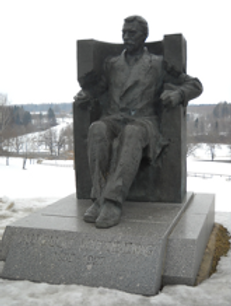
A. Kitzberg monument
BRICK MANUFACTURE IN KALKUNE
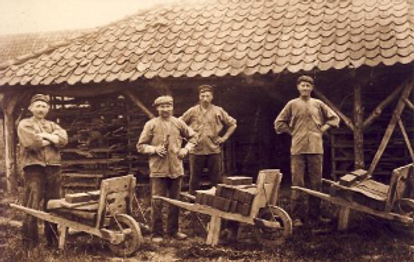
Clay is one of the most important natural resources of Latgale region. Since ancient times, it has been used for the production of various ceramic products. Archaeological findings show that the first ceramic products in Latgale appeared about 4500 years ago. At first they were unbaked but later craftsmen learned to burn them at a temperature of about 1000 ° c
The brick production industry in Latvia emerged in the 13th century when the German knights arrived in the Baltic states.
Throughout the whole country church construction began, mainly using wood, boulders and bricks, but until the 14th century the bricks were imported. The specific shape of bricks facilitated the construction and it had a beautiful red color; brick production began to spread throughout Latgale. The largest of first local brick factories was the one on the estate of the landowner Kuzopov.
Brick production has been especially important since 1810 when construction of the Dinaburg fortress began. For this, the land on the left bank of the Dvina was bought from Count Keyserling, the former chancellor of the Duchy of Kurzeme. In 1813, a factory with three stoves, a shed for drying bricks and rooms for storing tools were built there by the order of Major General Haeckel in order to restore the fortress which was destroyed by the French.
The plant worked for many years, usually during the summer season from June 1st to September 1st. Fourty-eight craftsmen and apprentices were employed there, mainly prisoners. Each experienced craftsman had to produce 250 unfired bricks a day. The working day was usually 14 hours: it began at 4 or 5 AM and ended at 7PM.


Bricks were shaped in oak molds, then dried in sheds or in the open air, and then burned in ovens.
The burning took five to seven days, but taking into account loading and unloading, the total production cycle lasted approximately fourteen days. For government orders, the brick size was precisely determined - 11 × 5 × 2.5 inches (279 × 127 × 63 mm); later they began to produce larger bricks - 305x152x76mm.
Twelve horizontal kneading machines for clay preparation were also installed. Since 1835, they started to use special presses. To reduce the number of defected items, only highly skilled workers were hired for this job. Their wages were around 14 rubles per 1000 finished bricks.
By 1857 there were in total fourteen brick workshops in the district. The largest of them was in Kalkune, which produced 1,980 million bricks and 5,000 tiles. Locally sourced peat was used as fuel for brick stoves.
In 1868, Baron August von Oetingen modernised the old factory, which employed about 40 people. The brick house “Katarinenhof” in Kalkune had been mentioned in historical records since 1874.

The Hoffman System
In 1902, a Russian merchant Vasily Karyakin (1851–1913) purchased the Kalkune estate and established a factory that had been operating for 30 years. Bricks were used to repair the church in the town of Egypt and the bell tower in 1863. They were also used for: construction of the German School in 1875 and the church; mill; and for the new building at the Kalkune estate; a church in the Niderkune parish; for the construction of residential houses and public buildings. A new architectural style has developed, so-called style of red brick, which can be seen in the historical centre of Daugavpils.
First World War brough some changes to brick production, and in the use of mechanics and electricity. Instead of an oven, new Hofmann furnaces with continuous arc (in the form of a ring) were now used.
By 1929, the three largest brick factories in the country, namely Kalkune, Pavilosta and Priekule, had the most advanced production technologies. The Kalkune brick factory was the largest brick-making enterprise in the Latgale region. It had a Hofmann arc furnace, brick dryers with a built-in mechanism for raising and lowering bricks, as well as two locomotives (75 horsepower) and one Junker’s diesel engine (25 horsepower) . There were also 7 equestrian brick presses and other advanced equipment.
The factory plant was equipped with narrow gauge railways and new technologies that made it possible to produce bricks even in the winter. The number of employees ranged from seventy to hundred people. By the end of the 20th century, 3-4 million bricks, as well as drainage pipes and tiles were produced in Kalkuni per year.
The production of cement began in the 1920s in Latvia; in the 1930s – production of slate, gypsum and other modern building materials emerged, although brick making remained a dominant industry. Many buildings in and around Daugavpils were built of Kalkune brick: for example, Daugavpils Old Believer Prayer House, as well as the House of Unity (1937).
After World War II, arose the need to restore the destroyed residential buildings and factories. Therefore, the production of brick and cement resumed. The Kalkune plant reopened in the autumn of 1944. After the refurbishment in 1947, clay mining site moved to a quarry located 0.5 km from the brick kiln and clay was transported there by narrow gauge railway.
At the beginning of the 20th century, the quality of Kalkune-produced bricks was quite low, as the equipment was outdated and the plant was not making a profit.
In 1958, after a secondary reconstruction, the Kalkune factory merged with the newly built silicate brick workshop in Daugavpils. The merged enterprise was named “Daugavpils brick factory” and belonged to the Ministry of Industry of Latvia. New low cost equipment for drying bricks was developed, and it significantly reduced the cost of brick production. The laborious manual work was replaced by a conveyor belt; unloading was carried out by a forklift truck and raw bricks were delivered by rail. Stoves used fuel oil (masut) for burning. The enterprise had 500 to 550 employees.
The production of agloporite (agloceramite) and vibro-brick panels began in Kalkune in 1960, for the first time in Latvia. Since 1961, the production of agloporite concrete wall panels became widespread both in Latvia and in other Soviet republics. The use of such panels in construction allowed to lower construction costs and significantly reduce construction time. Due to the diverse specialisation of the plant, on October 31st, 1961 the Daugavpils Brick Factory was renamed the Daugavpils Factory of Building Materials and Structures (abbreviated as DBMKR).

Nearly 30 million clay bricks were produced annually, the highest figure ever achieved by a brick factory in Kalkune. In 1970, the factory produced 23,730 m3 of concrete slabs.
Oversized wall panels, agglomerated concrete and three-layer reinforced concrete panels manufactured in Kalkune were first used in Latvia for building the Daugavpils Chemical Fiber Plant (1964), as well as construction of a pulp and paper mill in Sloka (1964).
In 1963, the factory of reinforced concrete structures began to produce concrete wall panels with marble chips. The first client was Riga Polytechnic Institute. From 1971 to 1973 DBMKR specialised in bulk building materials - panels for 103 houses; 12, 18 and 24 m long trusses; various types of blocks, as well as red and silicate bricks. They were used in the construction of the Olaine Plastics Plant; Rezekne Milking Equipment Plant; and new buildings in Jelgava, Riga and Kekava. During this time, 900 workers were employed. Many technological advancements have been made.
Clay mining in Kalkune was discontinued in 1976, and in the 1990s the plant ceased its operations.
KURZEME - ZEMGALE DUCHY

After the Livonian Order ceased to exist in 1562, a special treaty (Pacta subjectiones) marked the formation of the Kurzeme-Zemgale Duchy. The duchy existed until 1795. Its territory consisted of West of the Daugava River , namely, the regions of Kurzeme, Zemgale and Seliya. For more than two hundred years, it was reigned by two ducal dynasties - Kettler and Biron. Duchy’s first duke was the last master of the Livonian Order, Gotthard Kettler.


The duchy of Courland and Zemgale did not have major trade and craft centres like Riga, but in small seaports, such as Ventspils and Liepaja, the trade and shipbuilding were flourishing.
The duchy’s capital Jelgava (Mitava), as well as Bauska, Kuldiga and other cities were the core of craft and local trade. However, the main source of income for the duchy was agriculture. Vast lands belonged to the dukes, with private estates belonging predominantly to the Ostsee landowners, who were Courland’s nobility.

Mitau Ordensburg, 1703
Gotthard Kettler’s offspring Jacob Kettler (1610-1682) was ruling the duchy for nearly 40 years. Under his reign a lot of industries flourished, such as: production of iron and copper goods; production of textiles and glass in local manufactories; shipbuilding and increased fleet in Courland.
Jacob Kettler also sought to establish a colony - for a short time he ruled the island of Tobago in South America and the fort at the mouth of the Gambia River in Africa. The duchy’s fleet and all agriculture was destroyed in the Northern War, consequently, the control over the colonies was lost, and the duke himself was captured. In the last twenty years of his reign, the Duke Jacob unsuccessfully tried to regain his long gone power.

Jacob Kettler
At the beginning of the 18th century, the fate of the duchy was heavily influenced by the Great Northern War and the power struggles between governors. After the eighteen-year-old Duke Friedrich Wilhelm Kettler married the future Russian empress Anna Ioannovna, the duchy fell under jurisdiction of Russian Empire, despite previously being under the rule of the Polish-Lithuanian Commonwealth.
After the death of the last Kettler duke in 1737, a favorite of the Russian Empress, Ernest Johann Biron, became the Duke of the Duchy of Courland and Zemgale. Biron's ruling period is known not least for magnificent residences of the dukes: the largest were Rundale and in Jelgava palaces. The Biron Dynasty ruled the duchy until its accession to Russia in 1795.
Kalkune was first mentioned in 1519 when the master of the Livonian Order, Walter von Plettenberg, granted Johann von Felkersam the right to own the estate. The next owner of Kalkune estate, Count Dietrich von Kaiserling, moved to the Duchy of Courland from Westphalia.
The growth of international trade in Kurzeme-Zemgale Duchy was mainly due to seaports. They exported grain, flax, oil and hemp; and imported herring, salt, textiles, iron, wine, spices and luxury goods. Because Kalkune estate was located on the border of two states, it was closely connected to customs. From 1772 to 1795, Kalkune was separated from Dinaburg by the state border, and customs were located on the estate's territory.
MASTER WALTER FON PLETTENBERG AND LIVONIA
In the niche of the magnificent estate of Augustus von Ettingen, you were once able to find a statue that can only be seen in old photographs, because many wars and revolutions destroyed it. Images of this man can be found even on coins. He was an influential figure in the history of a vast territory of Livonia, which included modern Latvia and Estonia. This is a statue of Walter von Plettenberg - Master of Livonia. Kalkune (Calcuna) in the historical region of Celia (Semigallen) belonged to the Livonian Order.

The Middle Ages are largely known for Crusades, and the crusaders arrived to the territory of modern Latvia in 1186. They built a first stone temple in Ikskile and went on to built many others.
In 1205 the city of Riga was founded. Knights dedicated the lands of Livonia to Virgin Mary, calling them Terra Mariana. The Livonian Confederation existed for almost 400 years under the control of Comtours appointed by the Supreme Master of Prussia.
Crusader warriors (formerly known as the Order of the Swordsmen) wore white cloaks with a red cross embroidered on the left hand side. Amongst them were a lot of monks, but also a lot of people who wanted to make some money and adventure lovers. In addition, they were told their sins would be forgiven if they participated in the crusade.

Walter von Plettenberg ruled Livonia for more than 40 years. He was known as a wise and diplomatic ruler, and thanks to his visionary policies Livonia was able to stay out of war for 50 years. As a result, science and industry thrived, geographical discoveries were made, castles were built, and cities flourished.
By the way, one of his foreign policy objectives was aimed at strengthening the relationship with Russian Empire, which was then ruled by Ivan III. Plettenberg sent more than seven embassy delegations there within a period of three years.
Although, frankly, this did stop him from starting military operations in cooperation with the Principality of Lithuania. This later developed into a long and destructive Livonian war. Livonia did not win and consequently lost a part of itself - Northern Estonia was sold to the Danish king; the other part, which belonged to the master of Livonia and the lands of the Riga Archbishop were transferred to the Polish king Sigismund II Augustus.


YEKATERINA I
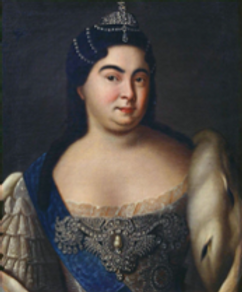
Yekaterina I Alekseevna (Marta Skavronskaya) (1684-1727) was the second wife of Peter I (Peter the Great) and the Empress of Russia from 1725 until her death.
Martha's origins are not exactly known. Some reports say she was the daughter of the peasant Samuel Skavronsky from Livonia, but according to others her father was a Swedish quartermaster I. Rabe.
Another version states that she was raised by a foster family that lived in Kalkune.
Martha's origins are not exactly known. Some reports say she was the daughter of the peasant Samuel Skavronsky from Livonia, but according to others her father was a Swedish quartermaster I. Rabe.
Another version states that she was raised by a foster family that lived in Kalkune. She did not receive any formal education, and spent her youth in the house of Pastor Gluck in Marienburg (now the city of Aluksne in Latvia), where she served as a laundress and a cook.
It is also likely that she was briefly married to a Swedish dragoon. In 1702, after the occupation of Marienburg by Russian troops, the future Russian empress became a war trophy and travelled back to the Russian court with B.P. Sheremetev (Peter’s I best friend). Around 1703, Peter the Great noticed Marta and was captivated by her beauty. She became one of his mistresses. Gradually, they developed a very close relationship.
Marta was soon baptised according to the Orthodox tradition under the name of Yekaterina Alekseyevna. She was known for her cheerful and empathetic nature. She easily put up with Peter's whims and his outbursts of causeless anger; she knew how to help him during his epilepsy fits and shared the difficulties of a camping life with him.Lonely and miserable in his personal life, Peter became very attached to Catherine and accepted their children together.
Catherine did not directly participate in political matters but she had a certain influence on the tsar. It is believed that she often spoke to the tsar as an intercessor of Prince Menshikov (close friend and associate of Peter I).
According to one legend, she saved the tsar when the Russian troops were surrounded during the Prut invasion. Catherine handed all her jewels over to the Turkish vizier, inclining him to sign a truce. Upon his return to St. Petersburg on February 19th 1712, Peter married Yekaterina, and their daughters Anna and Elizabeth (future Empress Yelizaveta Petrovna) received the official princess titles.
In 1714, in memory of the Prut campaign, the tsar instituted the Order of St. Catherine, and awarded his wife with it on her name day. In May 1724, Peter crowned Catherine as empress for the first time in Russian history. There is a theory that the tsar was planning to officially proclaim her his successor, but did not do this when he learned about her affair with Chamberlain V. Monsom.
After the death of Peter, Catherine was enthroned, not least due to the efforts of Menshikov. Since she herself did not have the necessary skills and knowledge to run the Empire, the Supreme Privy Council was created to rule the country, and Menshikov became its leader.
Among the most significant events of this time are the opening of the Academy of Sciences and the conclusion of an alliance with Austria, among other things.
Having become an autocratic sovereign, Catherine discovered a craving for constant entertainment. She spent a majority of her time at feasts, balls, various holidays, which adversely affected her health. She was barely interested in political affairs. Before her death, at the insistence of Menshikov, Catherine signed a will which stated that the throne was to be transferred to Grand Duke Peter Alekseevich, and in the event of his death, to her daughters or their descendants.

Empress Yekaterina
MICHAL KLEOFAS OGINSKI

Michal Kleofas Oginski was born on September 25th 1765 at the Guzow estate in the Masovian Voivodeship in Poland.
The Oginski princes of Western Ruthenian origin held various leadership positions in the Grand Duchy of Lithuania. Mikhal Kleofas’s great-grandfather was the Vitebsk governor; his grandfather and father were the Trok (Trakai) governors; and his uncle Michal Kazimir Oginsky was the Vilnius governor and the Great Lithuanian hetman.
The boy was taught by Jean Rolayn, one of the best teachers in Europe. He taught Oginski in such a way as to ensure the child a high level of both physical and mental development. At the age of 7 the boy was studying various sciences, from mathematics to political economy, up to 16 hours a day! Oginski also learned to play various instruments and compose music. Besides, he was fluent in all European languages.
At the early age of nineteen Michal Kleofas Oginski became a deputy of the parliament. Since 1789 he served as ambassador of the Commonwealth in the Netherlands and Great Britain. In 1793, at the age of 28, he became the Great Subcarpathian (that is, Minister of Finance) of the Grand Duchy of Lithuania.
In 1794, Oginski participated in the revolution for the restoration of the independence of the Commonwealth, led by Tadeusz Kosciuszko. Mikhal Oginski sold his estate, and with the raised money he formed and led a ranger battalion.
On July 31st, Oginski-led detachment took Ilukste and approached Dinaburg. They proposed an ultimatum to the commandant of the fortress, Colonel Heinrich Gulevich, demanding immediate surrender of the fortress without a fight. In exchange, Oginski promised let soldiers and officers go on parole; for this they were asked to go fight on the side of the rebels. Otherwise, the prince threatened "to look for the means to demolish the city with the sword and fire."
Colonel Gulevich, a brave officer who went through many military campaigns, refused to give up. But the forces were not equal. The fortress was defended by 50 soldiers and 170 peasants. The defenders of the fortress did not have enough weapons, gunpowder and provisions for a long-term defense, but they were ready to fight no matter what.
Empress Catherine II was kept informed of the state of affairs in Dinaburg.
"August 7th. The reports of the governor of Polotsk read that the Polish rebels were invading the province entrusted to him and had already embarked on Dinaburg”.
Oginski’s detachment fought a fierce battle on the streets of the city, and received a strong rebuff from the Dinaburgers. The rebels fled, but the city was burned to the ground. The fire, which began on August 3rd, 1794 destroyed all archival documents and materials accumulated in the city by that time. That is the reason why modern scholars have very scarce information about the history of the ancient city of Dinaburg. As legend has it, it was then that Oginsky, looking at the burning Dinaburg, wrote the melody for his famous polonaise “Farewell to the Motherland”.
After the suppression of the uprising in October 1794, Oginski, under the guise of a footman, reached the Austrian capital Vienna. His estates and all property in the territory of the former Commonwealth were confiscated by the Russian Empire and Prussia. He himself was put on the wanted list, and a large bounty was assigned for his head, so he moved from Vienna to Venice under the fake surname on December 1794.
The wife could not live in poverty and moved to her relatives in the former territory of Poland, which was part of Prussia, leaving Michal on his own. Oginski wanted to establish contact with the Sultan government in order to convince Turkey to start a war with Russia. In this case, it was possible to begin a new uprising and achieve the return of independence of the Commonwealth.
Negotiations with the Turkish government have not yielded any results and Oginski returns to France. There he met General Napoleon Bonaparte, who he also persuaded to make a campaign for the liberation of the Polish-Lithuanian Commonwealth, promising the support of the entire population. But Napoleon had different plans, and Mikhal Oginski decided that there was no point in staying in Paris, and moved to the Netherlands, where he had recently been an ambassador, and he was well known by the King William V.
Under the patronage of the king of the Netherlands, he was forgiven for participating in the uprising. In 1798 he was able to return to his wife. During their life in Prussia, they had two sons: in 1800 Tadeusz (named after General Kosciuszko), and in 1801 - Xavier. However, at the end of 1801 for reasons not yet clarified, Michal Kleofas Oginski divorced his wife. What happened between them - one can only guess.
In 1801, another event took place that drastically changed the life of Michal Kleofas Oginsky. Alexander I entered the Russian throne. One of Alexander’s closest friends was Adam Czartoryski, also the Lithuanian-Belarusian and Polish aristocrat but unlike Oginski he was not taking part in the uprising. Adam Czartoryski managed to convince Alexander to amnesty all the participants of the Kosciuszko uprising, and in 1802 Oginski was forgiven, and recovered all the estates previously confiscated from him. He settled in the Belarusian estate Zalesye.
At the age of 37, he married for the second time; it was the widow of his deceased friend, Count Kaetan Nagurski, 25-year-old Maria Nagurskaya. He was forced to divorce her in 1815.
Despite his misconduct against the Russian throne, M.K. Oginski was nevertheless appointed senator of the Russian Empire. After serving about two years, he quit his post, and in 1822 he left the country and moved to Florence. In 1831, in Florence, Michal Oginsky published a collection of his musical works, amongst which was the famous polonaise “Farewell to the Motherland”. In total, Oginski wrote over 60 compositions for piano, as well as several songs.
The composer died on October 15th 1833 in Florence, at the age of 68. He was buried in the Pantheon of outstanding personalities at the church of Santa Croce, next to Galileo Galilei, Michelangelo Buonarroti, Gioacchino Rossini and Niccolo Machiavelli.
JANIS RAINIS
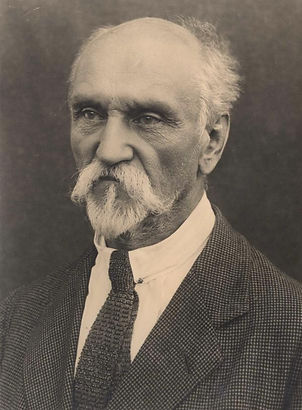
Janis Rainis (real name Janis Pliekšans) (1865-1929) was a poet, playwright, translator, theatre member, journalist and a politician.
Rainis was born in the Tadenava estate near Daugavpils, and spent his childhood and youth between the small towns of Rendene, Berkenele, Jasmuiza and Vasilevo. His father was very interested in breeding horses and participated in exhibitions with them.
In the Birkinele estate, which was rented from Augustus von Oetingen, Janis spent almost 9 years. While living there he attended German school, which was founded by Oetingen in 1875. Now it is known as the Janis Rainis Daugavpils School Number 6. He wrote his first poetry in these picturesque places. Now the Rainis Museum operates in Birkinele: a house where you can learn about the life of the poet where artists can hold their open airs.
Since 1880 he studied at the Riga City Gymnasium, and then enrolled in the Faculty of Law at St. Petersburg University. After his studies he then goes on to work as a lawyer in Vilnius (Vilno), Berlin, Panevezys and Jelgava. At the same time, Janis developed a strong interest in politics and literature, becoming an editor of the newspaper Dienas Lapa (Daily Leaflet).
He became one of the ideologists of the Social Democrat movement, writing both poems and political pamphlets. In 1897 Rainis was convicted of “making a revolution” and imprisoned. He was exiled to Pskov and the Vyatka province.
During his imprisonment, he translated the Goethe’s Faust into Latvian and wrote many poems. During the 1905 revolution, Rainis was actively involved in the movement. After the defeat of the revolution he left for Switzerland, where he lived until 1920. In Castanol, Switzerland Rainis writes his best poems, and the most famous plays: "New Power", "Silent Book", "Those Who Do Not Forget", "End and Beginning", "Ave sol "," Daugava "," Golden Horse "," Indulis and Aria”, “Joseph and his brothers", "I played, danced", "Raven", "Fire and night."
He returned to Latvia after it had already regained its independence. Back home he continued to participate in political life of the country. Rainis was elected as a deputy of the Constituent Assembly of Latvia and a member of Parliament. He was the director of the National Theatre of Latvia and a member of the first directorate of the Art Theatre; later he also held a position of the Minister of Education of Latvia. The poet ran for president of Latvia, but lost the election. Shortly before his death, he was awarded the highest award of the country - the Order of Three Stars.
Janis Rainis died in September 12th 1929 in Jurmala, at the age of 59.
Rainis' wife, a poet under the pseudonym Aspazia, was a famous women's rights advocate and activist.
